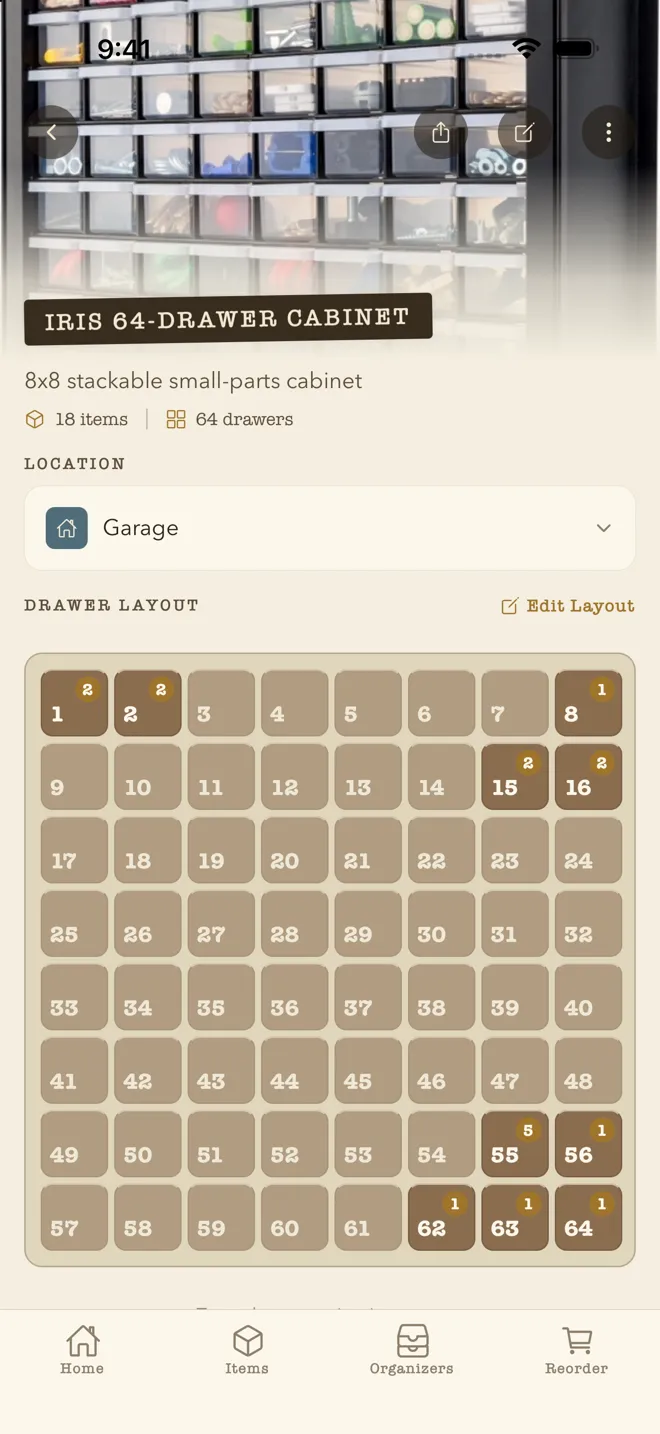
One of my fondest childhood memories is my father's workshop in the unfinished part of our basement — the land of winter firewood, spiders, and a pegboard wall that could hold almost anything. But the main attraction was the metal small-parts cabinet: rows and rows of little pull-out drawers, 8 across and 8 down.
Each drawer had a label of some sort. Masking tape and Sharpie. Dymo tape. Sometimes both, layered, in various stages of being crossed off, peeling off, or smudged off. And there was this unspoken understanding that the label represented a vague approximation of something that was very likely at one time in that drawer, and that you really couldn't trust it would still be there.
The true map of those “millions” of small parts lived in my father's head. It was tribal knowledge, passed down the way tribal knowledge always is: by standing next to him and asking, over and over, “where do you keep the…?”
Why labels rot
Labels fail for boring, predictable reasons — which means they're fixable:
- Drawers change purpose faster than labels change. Reprinting a label is a five-minute chore; moving a handful of parts is a five-second impulse. The parts win.
- Labels describe categories; you look for specific things. “Screws” is true and useless when you need the one that holds the dishwasher kick-plate on.
- Labels are one-way. They tell you what's supposed to be in a drawer. They can't tell you where the thing you're holding should go, or where its siblings are.
- Only one person maintains them. Which is fine, until that person isn't home, or forgets, or — eventually — isn't around to ask.
What actually works: keep the truth outside the drawer
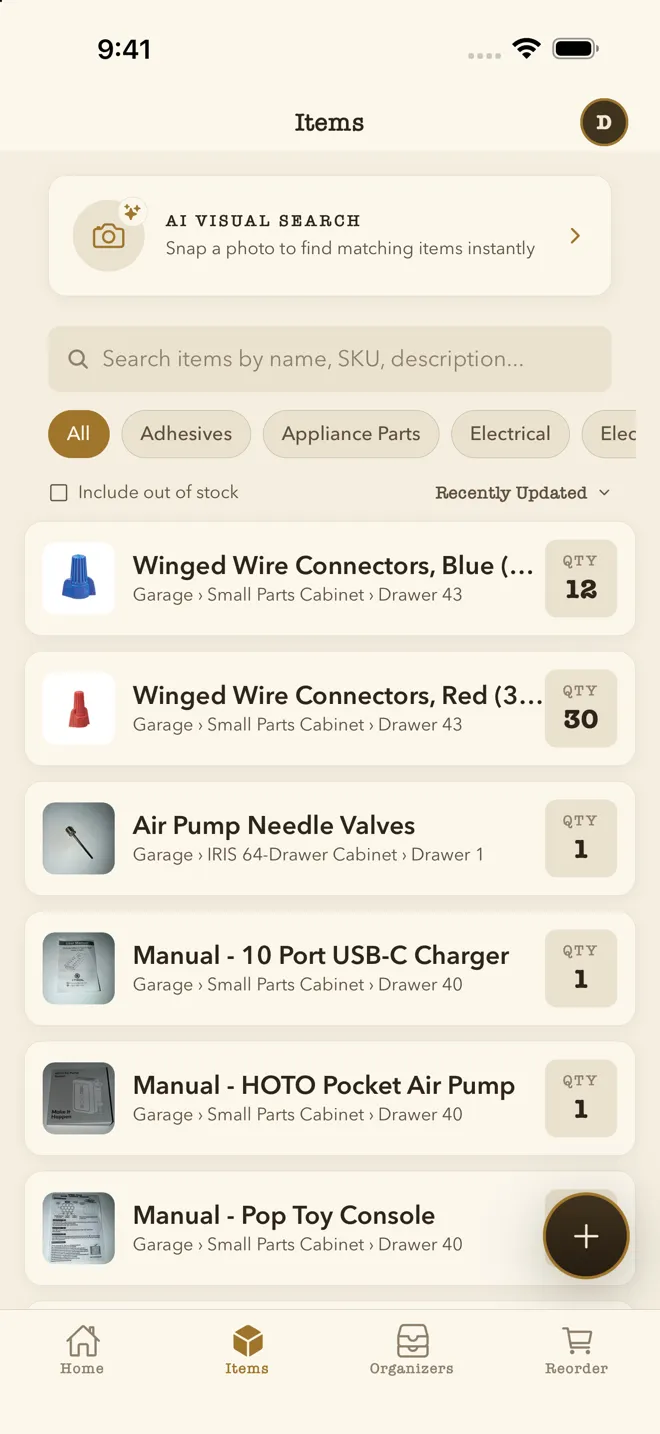
The fix is not a better label maker (though a Brother P-touch helps). The fix is an index that lives outside the cabinet and that everyone in the house can read. It should be photo-first, because small parts are hard to describe and easy to recognise, and it should be searchable, because nobody wants to scroll.
Three habits make the index truthful:
- Photograph the drawer, not just the part. A top-down photo of a drawer's contents is a snapshot of reality; it doesn't lie the way a label does.
- Update the index when the drawer's purpose changes, not “when you get around to it”. Make it a two-tap job or it won't happen.
- Let other people search it. The whole point is that the knowledge stops being tribal.
This is why WhichDrawer exists
You photograph the cabinet, draw the grid over it, and photograph what's in each drawer. Search by word or by photo — hold up the part, and the app tells you the drawer — and everyone in your household can see each other's organizers. It's a high-tech solution to a low-tech problem, and yes, I appreciate the irony. Free on the App Store for one organizer, with 20 AI image searches a month.
Here's to you, kids
May you have less stuff to organize. But may you also have a powerful way to organize the stuff you must keep around — you know, “just in case.” And may nobody have to stand next to you and ask where the M4 washers are.